Most Children Are Misunderstood, Not Under-Talented
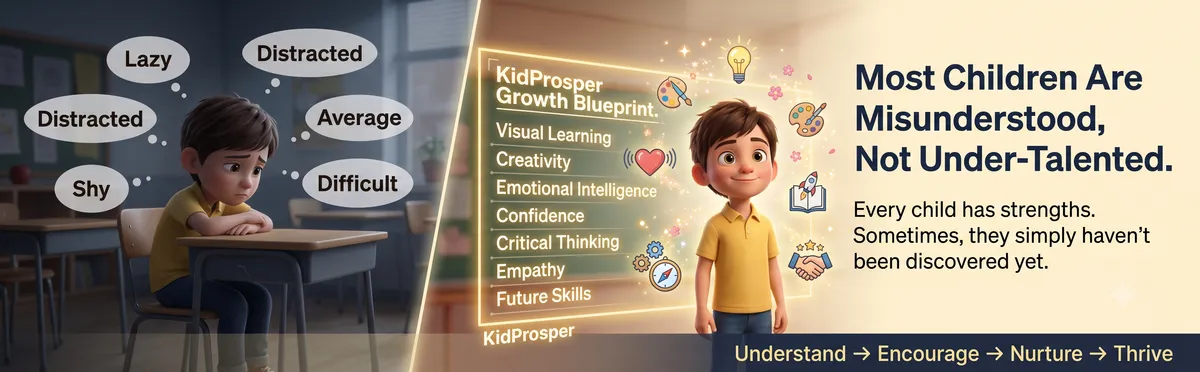
Somewhere in the world today, a child is being called:
Lazy.
Shy.
Distracted.
Difficult.
Average.
And somewhere else, another child is hearing:
"You're so smart."
"You're a natural leader."
"You're gifted."
But what if many of these labels are wrong?
What if the child labeled "difficult" simply feels misunderstood?
What if the child called "lazy" is struggling with motivation or confidence?
What if the child considered "average" possesses extraordinary strengths that nobody has noticed yet?
At KidProsper, we believe most children are misunderstood, not under-talented.
The Problem With Labels
Labels are convenient.
They help adults simplify complex behaviors.
Unfortunately, children are not simple.
Consider how often adults say:
"He's just shy."
"She's not very academic."
"He's not a leader."
"She's always emotional."
"He's never going to sit still."
Over time, labels become stories.
And children eventually begin believing those stories.
Children Become What They Believe
Imagine hearing the same message repeatedly throughout childhood:
"You're not good at math."
"You're not creative."
"You're too sensitive."
"You're difficult."
Eventually, many children stop saying:
"I haven't learned this yet."
And start saying:
"This is who I am."
That is the danger of misunderstanding.
Hidden Strengths Are Everywhere
Many strengths don't look impressive at first.
What Adults See | What Might Actually Be There |
|---|---|
Talks constantly | Strong communication skills |
Questions everything | Critical thinking |
Never sits still | Kinesthetic learning style |
Highly emotional | Deep empathy |
Daydreams frequently | Creativity and imagination |
Prefers working alone | Reflective thinking |
Sometimes, strengths arrive wearing disguises.
The World Rewards Different Strengths
History is filled with people who were underestimated as children.
Many successful adults were once described as:
Quiet.
Different.
Stubborn.
Distracted.
Unconventional.
The truth is:
Children do not need to fit into a single definition of success.
The world needs:
Artists.
Scientists.
Teachers.
Leaders.
Builders.
Thinkers.
Helpers.
And every one of those journeys begins with a child.
Why Adults Misunderstand Children
Adults often misunderstand children because they:
Compare them to siblings.
Compare them to classmates.
Focus on weaknesses.
Expect children to learn similarly.
Confuse behavior with identity.
Children are still becoming who they are.
We should not define their entire story from a single chapter.
The KidProsper Philosophy
KidProsper was built around a simple belief:
Every child has strengths. Every child deserves to be understood.
Through 40 developmental parameters, KidProsper helps parents identify:
Learning Styles
Personality Traits
Temperament
Emotional Intelligence
Motivation
Future Skills
Because understanding creates opportunities.
What Children Need Most
Children do not need adults who know everything.
They need adults who believe in them.
Every child deserves someone who says:
"I see you."
"I believe in you."
"You have strengths."
"We'll figure this out together."
"You are capable of amazing things."
Those words can change lives.
Five Signs a Child May Be Misunderstood
They are frequently compared to others.
They are described using labels rather than strengths.
Adults focus primarily on weaknesses.
Their interests are dismissed.
They are expected to fit into a single mold.
Five Things Parents Should Remember
Every child has strengths.
Behavior is not identity.
Growth is always possible.
Understanding comes before improvement.
Children become what they repeatedly hear about themselves.
Frequently Asked Questions
Can children outgrow labels?
Yes, especially when adults intentionally reinforce strengths and provide supportive environments.
What if my child struggles in school?
Academic challenges do not determine future success. Children possess many strengths beyond grades.
Why do some children seem difficult?
Behavior often reflects unmet needs, developmental differences, or communication challenges.
How can I identify my child's strengths?
Observe what energizes them, what they enjoy, and where they naturally show confidence and curiosity.
How does KidProsper help?
KidProsper helps parents identify and nurture strengths through assessments, Growth Blueprints, and personalized recommendations.
Related Articles
Every Child Is Different: Why Generic Parenting Advice Doesn't Work
Why Child Development Should Be Measured, Not Assumed
The Complete Parent's Guide to Understanding Your Child
Ready to Discover Your Child's Hidden Strengths?
Your child is more than their grades.
They are more than their behavior.
They are more than the labels they have been given.
Because most children are not under-talented. They are simply waiting to be understood.
Disclaimer: KidProsper is an educational and developmental platform intended to support parents through structured insights and recommendations. It is not a substitute for professional medical, psychological, or therapeutic advice.