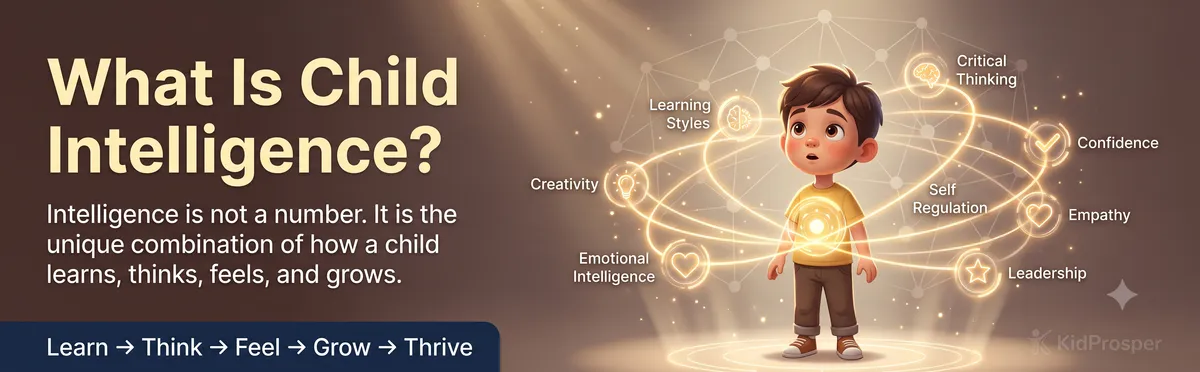
What Is Child Intelligence?
Ask ten people to define intelligence, and you'll probably receive ten different answers.
Some will say intelligence is:
IQ.
Grades.
Academic success.
Problem-solving ability.
Success in life.
But what if intelligence is much bigger than all of these?
At KidProsper, we believe intelligence is one of the most misunderstood concepts in parenting.
Because intelligence isn't simply about what children know.
It is about how they learn, think, feel, adapt, and grow.
Child intelligence is not a number. It is a blueprint.
The Traditional View of Intelligence
For decades, intelligence has largely been associated with:
IQ tests.
School performance.
Standardized testing.
Academic achievement.
These measures can provide useful insights.
However, they only capture a small part of who children are.
After all, report cards don't measure:
Empathy.
Confidence.
Resilience.
Leadership.
Creativity.
Emotional Intelligence.
And yet, these qualities often determine how children navigate life.
Child Intelligence Is Multidimensional
Imagine intelligence as a puzzle.
Every child possesses a different combination of pieces.
Those pieces may include:
Dimension | Examples |
|---|---|
Learning | Visual, Auditory, Kinesthetic |
Thinking | Creative, Logical, Reflective |
Emotions | Empathy, Self Awareness, Regulation |
Personality | Curiosity, Responsibility, Confidence |
Social Skills | Collaboration, Communication |
Future Skills | Adaptability, Leadership, Critical Thinking |
No two children will have exactly the same combination.
And that is precisely what makes every child extraordinary.
Every Child Has Their Own Intelligence Blueprint
Some children:
Learn best through movement.
Ask endless questions.
Comfort others naturally.
Solve problems creatively.
Demonstrate remarkable resilience.
These are all expressions of intelligence.
Unfortunately, many of these strengths are rarely measured.
This is why parents sometimes overlook the very qualities that will help children thrive in adulthood.
The Components of Child Intelligence
At KidProsper, child intelligence consists of multiple dimensions, including:
1. Learning Intelligence
Visual Learning
Auditory Learning
Kinesthetic Learning
2. Cognitive Intelligence
Critical Thinking
Creativity
Problem Solving
Decision Making
3. Emotional Intelligence
Emotion Recognition
Emotion Regulation
Self Awareness
4. Social Intelligence
Empathy
Collaboration
Relationship Management
5. Personal Intelligence
Confidence
Motivation
Resilience
Self Regulation
Together, these dimensions create a child's unique intelligence profile.
Can Intelligence Be Improved?
Absolutely.
One of the biggest myths about intelligence is that it is fixed.
In reality, children grow continuously.
They can improve:
Confidence.
Communication.
Critical Thinking.
Leadership.
Emotional Intelligence.
Self Regulation.
At KidProsper, our philosophy is simple:
Every child can grow. Every child can improve.
The earlier parents begin supporting development, the greater the impact.
Why Understanding Intelligence Matters
When parents understand intelligence differently, they parent differently.
Instead of asking:
"Why isn't my child performing better?"
They begin asking:
"How does my child learn?"
"What motivates them?"
"What are their strengths?"
"How can I support them better?"
That shift transforms parenting.
How KidProsper Measures Child Intelligence
KidProsper evaluates children across 40 developmental parameters grouped into 10 assessments.
These assessments help parents understand:
Learning Styles.
Learning Approaches.
Cognitive Styles.
Attitude.
Temperament.
Personality.
Self Control.
Emotional Intelligence.
Social Emotional Learning.
Influences and Interests.
The result is a personalized Growth Blueprint and KP Growth Score that help families understand and nurture their child's potential.
Five Signs of Child Intelligence
Curiosity about the world.
Asking thoughtful questions.
Showing empathy toward others.
Finding creative solutions.
Persisting through challenges.
Notice that none of these mention grades.
Common Misconceptions About Intelligence
Intelligence is fixed.
IQ determines success.
Top students are always the smartest.
Creativity is less important than academics.
Children who struggle in school lack intelligence.
All of these statements are incomplete.
Frequently Asked Questions
What is child intelligence?
Child intelligence is the unique combination of how a child learns, thinks, feels, communicates, and adapts to the world.
Is intelligence the same as IQ?
No. IQ is one measure of intelligence, but it does not capture emotional, social, or behavioral dimensions.
Can intelligence improve over time?
Yes. Many aspects of intelligence can be nurtured through experiences, activities, habits, and supportive environments.
Does every child have strengths?
Absolutely. Every child possesses strengths, even if they are not immediately visible through traditional measures.
How does KidProsper help?
KidProsper helps parents understand and nurture child intelligence through assessments, Growth Blueprints, KP Growth Scores, activities, and AI-powered coaching.
Related Articles
What Is KidProsper? The World's First Child Intelligence Operating System
Most Children Are Misunderstood, Not Under-Talented
Beyond Grades: Why Report Cards Don't Tell the Full Story
Ready to Discover Your Child's Intelligence Blueprint?
Your child's intelligence cannot be captured by a single test score.
It lives in their curiosity.
Their creativity.
Their empathy.
Their resilience.
Because intelligence isn't just about what children know. It's about who they are becoming.
Disclaimer: KidProsper is an educational and developmental platform intended to support parents through structured insights and recommendations. It is not a substitute for professional medical, psychological, or therapeutic advice.