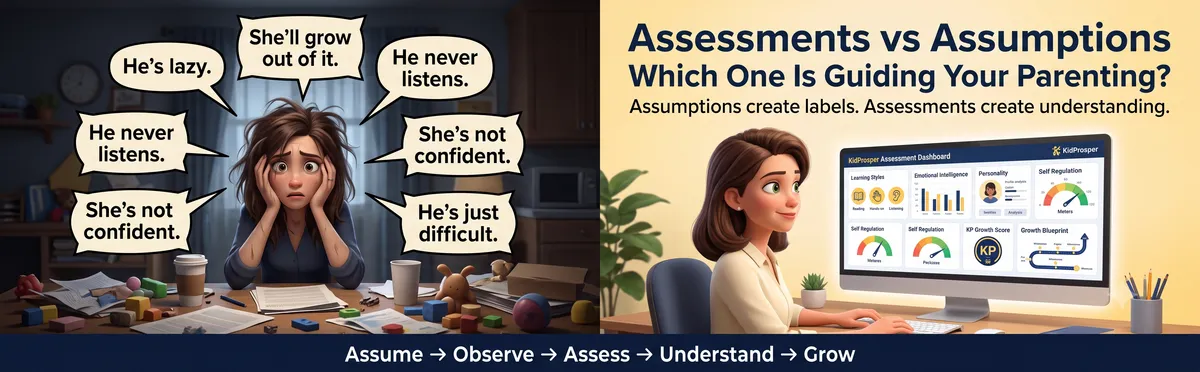
Assessments vs Assumptions: Which One Is Guiding Your Parenting?
Every parent makes assumptions.
It's human nature.
We say things like:
"My child is lazy."
"She just isn't confident."
"He's not interested in learning."
"She's too emotional."
"He'll never sit still."
Most of the time, these statements aren't made with bad intentions.
They're attempts to make sense of behaviors we don't fully understand.
But there is one important question every parent should ask:
Are we parenting based on assessments or assumptions?
The Problem With Assumptions
Assumptions are often built from:
Single experiences.
Emotions.
Comparisons.
Expectations.
Past experiences.
For example:
Assumption | Possible Reality |
|---|---|
My child is lazy. | They may lack motivation or confidence. |
My child doesn't listen. | They may learn differently. |
My child is shy. | They may simply be reflective. |
My child is difficult. | They may struggle with emotional regulation. |
My child isn't smart. | Their strengths may not be academic. |
Assumptions simplify children.
But children are anything but simple.
What Is an Assessment?
An assessment is a structured way of understanding patterns.
Instead of asking:
"What's wrong with my child?"
Assessments ask:
How does this child learn?
What motivates them?
How do they handle challenges?
Which strengths do they possess?
What support would help them thrive?
Assessments move parenting from guesswork to clarity.
Why Parents Need Assessments
Imagine making important decisions without information.
Doctors use medical tests.
Teachers use evaluations.
Athletes use performance metrics.
Businesses use analytics.
Yet parents are often expected to understand the most important people in their lives without structured insights.
That doesn't make sense.
The Cost of Parenting Through Assumptions
Assumptions can lead to:
Misunderstanding.
Frustration.
Incorrect expectations.
Labels.
Missed opportunities.
Over time, assumptions become stories.
And stories become identities.
Children begin believing:
"I'm bad at school."
"I'm not creative."
"I'm difficult."
"I'm not a leader."
Those beliefs can last a lifetime.
The Benefits of Assessments
Assessments provide:
Clarity.
Confidence.
Consistency.
Personalization.
Better decisions.
Parents who understand their children are better equipped to:
Communicate effectively.
Support strengths.
Build confidence.
Develop future skills.
Strengthen relationships.
Assessments Are Not Labels
This is important.
Assessments should never define children.
They should help us understand them.
At KidProsper, we believe:
Assessments should open doors—not close them.
Children grow.
They change.
They surprise us.
Assessments simply provide a starting point.
The KidProsper Approach
KidProsper helps parents understand children across 40 developmental parameters.
These include:
Learning Styles
Learning Approaches
Cognitive Styles
Attitude
Temperament
Personality
Self Control
Emotional Intelligence
Social Emotional Learning
Influences and Interests
Together, these assessments create a personalized Growth Blueprint.
Because understanding should always come before improvement.
Five Questions to Ask Yourself
What assumptions have I made about my child?
Are those assumptions based on evidence?
What strengths might I be overlooking?
How does my child learn best?
What would change if I understood them better?
Five Signs You're Parenting Through Assumptions
You frequently compare your child to others.
You use labels more than observations.
You focus primarily on weaknesses.
You assume all children learn similarly.
You often say, "That's just who they are."
Five Signs You're Parenting Through Understanding
You observe before reacting.
You ask questions.
You recognize strengths.
You adapt your parenting approach.
You celebrate growth over perfection.
Frequently Asked Questions
Are assumptions always bad?
No. Assumptions are natural, but they should be challenged and validated through observations and assessments.
Can assessments improve parenting?
Yes. Assessments provide clarity and help parents make more informed decisions.
Do assessments label children?
No. Assessments are tools for understanding, not defining, children.
What does KidProsper assess?
KidProsper evaluates children across 40 developmental parameters to provide personalized insights.
What is the biggest difference between assumptions and assessments?
Assumptions are guesses. Assessments are structured observations.
Related Articles
Why Child Development Should Be Measured, Not Assumed
Most Children Are Misunderstood, Not Under-Talented
The Complete Parent's Guide to Understanding Your Child
Ready to Move Beyond Guesswork?
Your child deserves more than assumptions.
They deserve understanding.
Because parenting becomes easier when we stop asking, "What's wrong with my child?" and start asking, "What is my child trying to tell me?"
Disclaimer: KidProsper is an educational and developmental platform intended to support parents through structured insights and recommendations. It is not a substitute for professional medical, psychological, or therapeutic advice.