Activities vs Habits: What Creates Long-Term Change?
Parents love activities.
And for good reason.
Activities are exciting.
Science experiments.
Puzzle challenges.
Reading games.
Emotion charades.
Creative projects.
They create memorable moments.
But here's an important question:
Can a single activity change a child's life?
Usually, no.
Long-term change happens differently.
It happens through habits.
What Are Activities?
Activities are intentional experiences designed to develop specific skills.
Examples include:
Building a LEGO tower.
Playing memory games.
Reading together.
Practicing empathy exercises.
Completing a problem-solving challenge.
Activities are valuable because they:
Introduce new ideas.
Develop skills.
Create engagement.
Build confidence.
Strengthen relationships.
Think of activities as planting seeds.
What Are Habits?
Habits are behaviors repeated consistently over time.
Examples include:
Reading for 15 minutes every evening.
Making the bed every morning.
Sharing one gratitude at dinner.
Completing one daily chore.
Practicing emotional check-ins.
Habits are powerful because they happen repeatedly.
Think of habits as watering the seeds.
Activities Create Moments
A child may complete:
One puzzle.
One kindness activity.
One creativity challenge.
One family discussion.
Those moments matter.
They teach children:
I can solve problems.
I can be creative.
I can help others.
I can learn new things.
Activities create possibilities.
Habits Create Identity
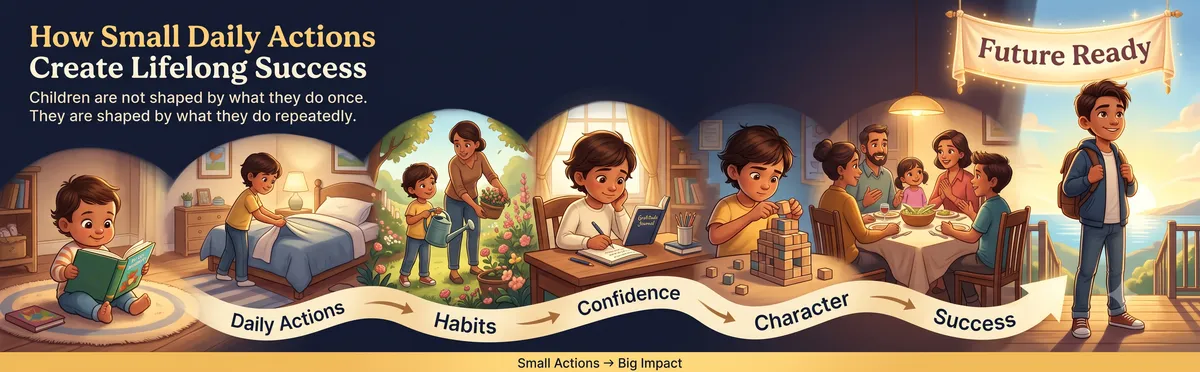
When activities become habits, something remarkable happens.
Children begin saying:
"I am a reader."
"I am responsible."
"I am kind."
"I am resilient."
"I am capable."
Identity is built through repetition.
Children become what they repeatedly do.
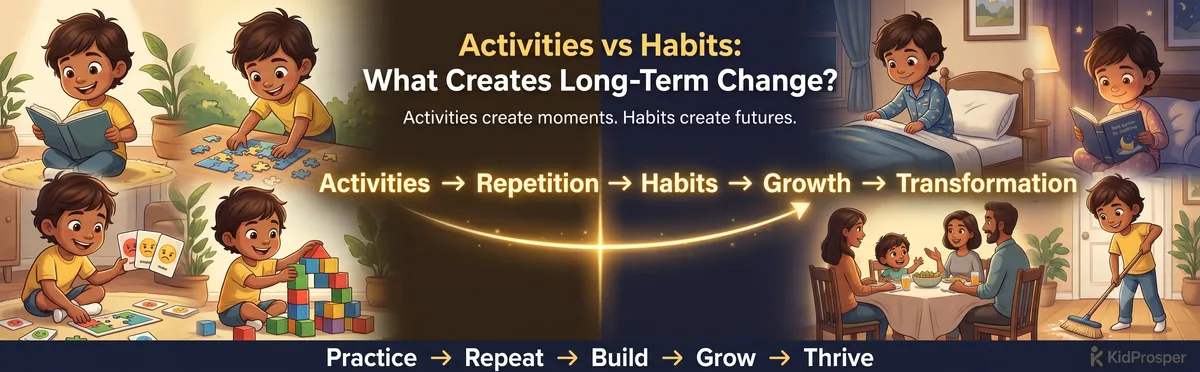
The Formula for Long-Term Change
At KidProsper, we believe long-term growth follows a simple formula:
Step | Outcome |
|---|---|
Activity | Introduces a skill |
Repetition | Builds familiarity |
Habit | Creates consistency |
Growth | Builds capability |
Transformation | Shapes identity |
Activities begin the journey.
Habits complete it.
Examples From Everyday Life
Activity | Habit | Long-Term Result |
|---|---|---|
Read one book | Read daily | Lifelong learner |
Practice gratitude once | Daily gratitude | Positive mindset |
Help with chores | Daily responsibilities | Responsibility |
Play a memory game | Regular brain challenges | Critical thinking |
Emotion discussion | Daily emotional check-ins | Emotional intelligence |
The difference is consistency.
Why Parents Often Focus on Activities
Activities provide immediate satisfaction.
Parents can say:
"We did something productive today."
"That was fun."
"My child enjoyed that."
Habits are different.
They are often:
Small.
Repetitive.
Unexciting.
Easy to overlook.
Yet habits are where transformation happens.
The KidProsper Approach
KidProsper combines both activities and habits.
Our philosophy is simple:
Activities introduce growth. Habits sustain it.
Every recommendation inside KidProsper is designed to:
Develop strengths.
Support growth areas.
Build consistency.
Create lasting change.
Because children don't change in a day.
They change through thousands of small moments.
Five Habits That Change Children's Lives
Reading every day.
Completing one responsibility daily.
Practicing gratitude.
Discussing emotions openly.
Reflecting on the day's successes.
Five Activities Every Family Should Try
Emotion Charades.
LEGO Problem Solving Challenges.
Family Story Night.
Creativity Challenges.
Weekly Growth Meetings.
Frequently Asked Questions
Which is more important: activities or habits?
Both are important. Activities introduce skills, while habits reinforce them over time.
How long does it take to build a habit?
Habit formation varies from child to child. Consistency is more important than speed.
Can habits improve confidence?
Yes. Small daily wins help children build confidence and self-belief.
How does KidProsper use activities and habits?
KidProsper provides personalized activities and habit recommendations based on each child's Growth Blueprint.
What is the biggest takeaway?
Activities create moments. Habits create futures.
Related Articles
Why Every Child Needs a Growth Blueprint
The 5 Tiers of Child Growth Explained
Building Future-Ready Children: Skills That Matter in 2035
Ready to Build Lasting Change?
Your child's future will not be determined by one extraordinary day.
It will be shaped by ordinary days repeated consistently over time.
Because small actions, repeated daily, have the power to transform lives.
Disclaimer: KidProsper is an educational and developmental platform intended to support parents through structured insights and recommendations. It is not a substitute for professional medical, psychological, or therapeutic advice.